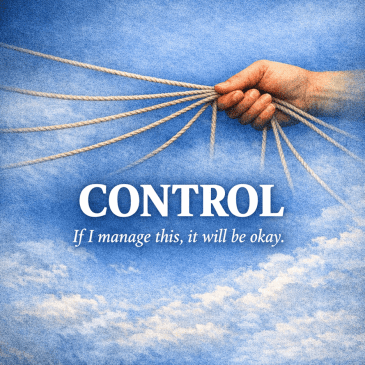
Uncertainty Tightens—and You Start Organizing Everything
The moment something feels uncertain, you feel it in your body first.
Not panic—more like a tightening. A subtle urgency.
You start doing what you do best: organizing. Planning. Taking initiative.
You replay the conversation, the situation, the timing—then begin mentally arranging the next steps like pieces on a board.
You send the follow‑up text. You outline the plan. You anticipate the problems before they appear.
You tell yourself you’re just being responsible. Being proactive. Being wise.
And maybe you are.
- But underneath the competence is a quieter belief:
- Rest will come after everything is handled.
- Peace will come after everything is secure.
- Relief will come after you’ve made sure nothing can fall apart.
What Control Sounds Like
Control rarely sounds harsh.
It sounds capable. It sounds helpful. It sounds like leadership.
It doesn’t say, “I can’t handle this.” It says:
- “Let me take care of it.”
- “I’ll just make a plan.”
- “If we do it this way, it’ll work.”
- “We can’t leave this to chance.”
- “I just need to get ahead of it.”
Control often feels trustworthy because it produces results.
It moves quickly. It reduces chaos. It creates structure.
But it also has a tell.
It becomes difficult to sit inside uncertainty without trying to manage it.
What Control Is Trying to Do
Control isn’t the enemy.
In many moments, it’s a genuine strength—especially when life requires steadiness, leadership, or care.
Control becomes problematic when it stays in charge long after the moment requires it.
- Managing replaces relating
- Structure replaces presence
- Responsibility avoids vulnerability
Control watches closely for what could unravel and tries to secure the outcome.
It believes safety comes from containment—from planning, predicting, coordinating, and making sure things don’t spiral.
Control doesn’t trust waiting.
It trusts handling.
Control in the Inner Life
When control shapes the inner life, the mind becomes a manager.
It scans for loose ends. It organizes emotions into tasks. It turns discomfort into something to solve.
Even rest can start to feel like a problem to optimize:
- “If I finish these three things, then I can relax.”
- “If I just get clarity, then I’ll feel better.”
Over time, control can crowd out softness. You may still be functioning well—maybe even excelling—but something inside you is always braced, always arranging, always holding.
Life doesn’t feel chaotic.
It feels monitored.
It feels managed.
It feels hard to exhale inside.
Control in Relationships
In relationships, control often shows up as “help.”
You anticipate needs before they’re named. You offer solutions quickly. You try to prevent mistakes, discomfort, conflict, or disappointment.
It can sound like care.
- “I’m just trying to make this easier.”
- “I don’t want this to become a bigger issue.”
- “If we handle it now, we won’t have to deal with it later.”
But over time, control can reshape the relationship without anyone noticing. One person becomes the stabilizer, the coordinator, the emotional weather monitor—and the other may begin to feel managed rather than met.
Control can reduce conflict in the short term, but it often does so by reducing mutuality. Decisions get narrowed. Conversations get directed. Space for messiness—space for another person’s process—starts to feel unsafe.
Control rarely harms relationships through explosion. More often, it does so through subtle takeover: solving too fast, steering too often, holding too tightly.
A Noticing Close
Control doesn’t need to be shamed to loosen its grip.
It needs to be noticed.
When control is named for what it is—not wisdom, not maturity, not love—it no longer gets to quietly run the inner life or the relationship.
Sometimes the most important shift isn’t doing less. It’s recognizing what feels at stake when you can’t manage the outcome. Because underneath control is usually a fear it doesn’t want to feel: “If I don’t hold this together, something will fall apart.”
Naming control creates a choice point—a moment where another authority can lead instead.
Not chaos. Not passivity.
But presence. Trust. Relational strength that doesn’t require managing everything to feel safe.
You May Notice This Alongside…
- Discernment — when authority returns inward
- Fear — when uncertainty drives the need to manage
- People Pleasing — when control shifts toward harmony

