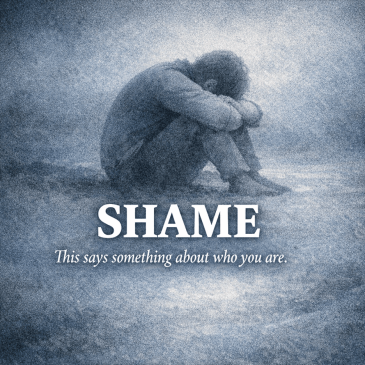
A Small Moment Feels Like a Verdict
It’s a small moment.
A mistake. A misunderstanding. A look you didn’t expect.
Nothing dramatic happens—but something inside you drops.
Your attention turns inward.
You replay what you did, how you sounded, how you appeared.
The event fades quickly.
The meaning does not.
You don’t just feel regret.
You feel exposed.
It’s not about what happened.
It’s about what it seems to reveal.
What Shame Sounds Like
Shame doesn’t shout.
It settles.
It doesn’t say, “You messed up.”
It says:
- “This is who you are.”
- “Of course you’d do that.”
- “People can see through you.”
- “You’re not who you should be.”
Shame feels convincing because it frames itself as truth‑telling.
Not accusation—clarity.
Its tell isn’t intensity.
It’s the way identity gets wrapped around a single moment.
What Shame Is Trying to Do
Shame isn’t punishment.
It’s an attempt at control through meaning.
It believes exposure equals danger.
That visibility risks rejection.
That survival requires self‑containment.
Shame interprets experience in a way that limits risk:
Stay small.
Stay hidden.
Don’t draw attention.
Shame doesn’t trust belonging.
It trusts self‑monitoring.
Shame in the Inner Life
When shame shapes the inner life, attention turns inward—but not with care.
With scrutiny.
The self becomes a problem to manage.
Worth becomes conditional.
Confidence feels fragile.
Over time, shame shrinks internal space.
You may function well—
but something inside you stays guarded.
Life doesn’t feel chaotic.
It feels constricted.
Quietly diminished.
Shame in Relationships
In relationships, shame often leads to withdrawal. Not physical distance—but emotional retreat.
You may hold back opinions.
Downplay needs.
Avoid being fully seen.
Shame rarely damages relationships through conflict.
More often, it does so through invisibility.
A Noticing Close
Shame loosens its grip when it’s named as interpretation—not truth.
A moment is not an identity.
Exposure is not a verdict.
Noticing shame creates space for something else to speak—
not denial, not self‑correction,
but compassion grounded in reality rather than conclusion.
You May Notice Shame Alongside…
- Inner Critic — when meaning turns corrective
- Avoidance — when exposure feels unsafe
- Compassion — when identity loosens from verdict

